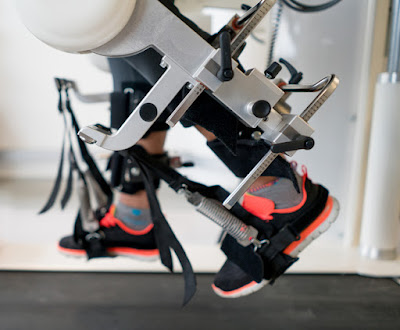
Showing posts with label Rehabilitation robots. Show all posts

Thursday, 18 November 2021

The field of Research Dedicated to Extending Rehabilitation through the Deployment of Robotic devices is called Rehabilitation Robots.

Rehabilitation robots

Rehabilitation robots is a field of research dedicated to understanding and augmenting rehabilitation through the application of robotic devices. Rehabilitation robotics includes development of robotic devices tailored for assisting different sensorimotor functions[, development of different schemes of assisting therapeutic training, and assessment of sensorimotor performance of patient; here, robots are used mainly as therapy aids instead of assistive devices. Rehabilitation using robotics is generally well tolerated by patients, and has been found to be an effective adjunct to therapy in individuals suffering from motor impairments, especially due to stroke.
Rehabilitation robots are built with approaches that determine the patient's adaptability level in mind. Active assisted exercise, active confined exercise, active resistive exercise, passive exercise, and adaptive exercise are examples of techniques. Active aided exercise involves the patient moving his or her hand along a specified course with no force pushing against it. Active confined exercise is the movement of the patient's arm with an opposing force; if it tries to move outside of what it is supposed to, it is deemed ineffective. The movement with opposing forces is known as active resistance exercise.

The number of rehabilitation robots has expanded over the years, however they are extremely limited due to clinical trials. Many clinics have trials but refuse to adopt the robots because they desire they could be managed remotely. There are a few advantages of involving robots in a patient's rehabilitation. One of the advantages is that you can repeat the process or exercise as many times as you want. Another advantage is that you can obtain precise measurements of their improvement or deterioration. The sensors on the device can provide precise measurements. While the device is taking a measurement you need to be careful because the device can be disrupted once it is done because of the different movements the patient does to get out.The rehabilitation robot can apply constant therapy for long periods. In the process of a recovery the rehabilitation robot is unable to understand the patient’s needs like a well experienced therapist would.The robot is unable to understand now but in the future the device will be able to understand. Another plus of having a rehabilitation robot is that there is no physical effort put into work by the therapist.

Monday, 14 June 2021

Rehabilitation Robots, Their Applications, and Different Rehabilitation Robotic Paradigms for Home, Clinic, and Hospital Use


Rehabilitation robots


Rehabilitation robots, otherwise called portability and self-sufficiency robots, are machines, which assist patients with fractional or all out loss of motion to recover their capacity to move or perform exercises of every day living. These robots are ideal for home medical services and patient consideration. The robots can aid every day errands like taking care of, strolling, or working domestic devices.
Restoration advanced mechanics includes examining the body's recovery cycles to plan robots that can help in such undertakings as getting a pen or a spoon, pushing a wheelchair or prop, or getting an article. Likewise, recovery robots can be customized to play out specific assignments relying upon the circumstance. There are a few Rehabilitation Robotic Paradigms for use in homes, facilities, emergency clinics, and other clinical focuses. These robots are likewise offered on a rental premise in different nations like Japan, China, and the U.S. The market is seeing dispatch of new items also. In October 2020, PTR Robots, a Danish assistance robot organization, dispatched its robot that can assemble and move patients.
The principal Paradigm, Neurorehabilitation, has zeroed in on contemplating the advancement of amputees' engine abilities and tactile pathways. This program has created a few distinctive rehabilitation robots including a Robotic Arm and Leg System that had the option to get an item and spot it in the ideal area; a Robotic Drum System that permit a drum-like independent unit to move sound starting with one territory then onto the next; and a Robotic Headset that can speak with the client and train the person in question to perform neurorehabilitation works out. A few different innovations are being developed that will help enhance these significant frameworks.
The subsequent Paradigm, Physical Removable Body System, has focused on concentrating how to plan a restoration robot to utilize the human appendage developments of an incapacitated patient. An actual removable body framework can incorporate arm, legs, and middle to mimic common development. Albeit this innovation is as yet in the beginning phases, a few significant advantages are being considered such to be the chance of utilizing prosthetics to control prosthetic appendages and utilizing body attention to forestall further injury.


The third Paradigm, Human-Computer Interaction, has inspected the connection among neurorehabilitation and the association of a restoration robot. This cutting edge innovation is intended to work related to a person and utilize genuine collaboration to show an incapacitated patient how to recapture free development. One test in planning this sort of recovery robot is the investigation of how best to fuse common human developments with the computerized reasoning of a PC program. Analysts have investigated coordinating voice orders and hand developments into a PC controlled unit. Another thought manages how to permit a patient to control their PC interface with their own neural organization. A few organizations have additionally put resources into business systems that permit patients to control their recovery robots from a good ways.

Tuesday, 20 April 2021

Rehabilitation Robots, Their Applications, and Different Rehabilitation Robotic Paradigms for Home, Clinic, and Hospital Use


Rehabilitation robots, otherwise called portability and self-sufficiency robots, are machines, which assist patients with fractional or all out loss of motion to recover their capacity to move or perform exercises of every day living. These robots are ideal for home medical services and patient consideration. The robots can aid every day errands like taking care of, strolling, or working domestic devices.

Restoration advanced mechanics includes examining the body's recovery cycles to plan robots that can help in such undertakings as getting a pen or a spoon, pushing a wheelchair or prop, or getting an article. Likewise, recovery robots can be customized to play out specific assignments relying upon the circumstance. There are a few Rehabilitation Robotic Paradigms for use in homes, facilities, emergency clinics, and other clinical focuses. These robots are likewise offered on a rental premise in different nations like Japan, China, and the U.S. The market is seeing dispatch of new items also. In October 2020, PTR Robots, a Danish assistance robot organization, dispatched its robot that can assemble and move patients.
The principal Paradigm, Neurorehabilitation, has zeroed in on contemplating the advancement of amputees' engine abilities and tactile pathways. This program has created a few distinctive rehabilitation robots including a Robotic Arm and Leg System that had the option to get an item and spot it in the ideal area; a Robotic Drum System that permit a drum-like independent unit to move sound starting with one territory then onto the next; and a Robotic Headset that can speak with the client and train the person in question to perform neurorehabilitation works out. A few different innovations are being developed that will help enhance these significant frameworks.
The subsequent Paradigm, Physical Removable Body System, has focused on concentrating how to plan a restoration robot to utilize the human appendage developments of an incapacitated patient. An actual removable body framework can incorporate arm, legs, and middle to mimic common development. Albeit this innovation is as yet in the beginning phases, a few significant advantages are being considered such to be the chance of utilizing prosthetics to control prosthetic appendages and utilizing body attention to forestall further injury.

The third Paradigm, Human-Computer Interaction, has inspected the connection among neurorehabilitation and the association of a restoration robot. This cutting edge innovation is intended to work related to a person and utilize genuine collaboration to show an incapacitated patient how to recapture free development. One test in planning this sort of recovery robot is the investigation of how best to fuse common human developments with the computerized reasoning of a PC program. Analysts have investigated coordinating voice orders and hand developments into a PC controlled unit. Another thought manages how to permit a patient to control their PC interface with their own neural organization. A few organizations have additionally put resources into business systems that permit patients to control their recovery robots from a good ways.


Thursday, 15 April 2021

Rehabilitation Robots Market: Global Industry Trends, Share, Size, Growth, Opportunity and Forecast


Rehabilitation robots are planned with utilizations of strategies that decide the flexibility level of the patient. Methods incorporate yet are not restricted to dynamic helped work out, dynamic obliged work out, dynamic resistive exercise, latent exercise, and versatile exercise. In dynamic helped work out, the patient moves their hand in a foreordained pathway with no power pushing against it. Dynamic obliged practice is the development of the patient's arm with a restricting power; in the event that it attempts to move outside of what it should. Dynamic resistive exercise is the development with contradicting powers. These machines MIT-Manus, Bi-Manu-Track and MIME make the dynamic resistive exercise conceivable. Inactive exercise should be pushed from the patient. At long last, a versatile exercise is an inordinate exercise that the robot has never done and is adjusting to the new obscure pathway. These gadgets Bi-ManuTrack and MIME support the versatile exercise conceivable. The dynamic compelled practice is upheld by every one of the machines that are referenced.
Throughout the long term the quantity of recovery mechanical technology has developed however they are extremely restricted because of the clinical preliminaries. Numerous centers have preliminaries yet don't acknowledge the robots since they want to be distantly controlled. Having Robots engaged with the restoration of a patient has a couple of positive perspectives. One of the positive viewpoints is the way that you can rehash the interaction or exercise however many occasions as you wish. Another positive viewpoint is the way that you can get careful estimations of their improvement or decay. You can get the specific estimations through the sensors on the gadget. While the gadget is taking an estimation you should be cautious in light of the fact that the gadget can be disturbed whenever it is done on account of the various developments the patient never really out. The rehabilitation robot can apply consistent treatment for extensive stretches. The rehabilitation robot is an awesome gadget to use as per numerous advisors, researchers, and patients that have gone through the treatment. During the time spent a recuperation the recovery robot can't comprehend the patient's requirements like a very much experienced advisor would.The robot can't see now however later on the gadget will actually want to comprehend. Another in addition to of having a rehabilitation robot is that there is no actual exertion placed into work by the advisor.
Recently, recovery advanced mechanics have been utilized in preparing medication, medical procedure, distant medical procedure and different things, yet there have been such a large number of objections about the robot not being constrained by a far off. Numerous individuals would feel that utilizing a modern robot as a rehabilitation robot would be exactly the same thing, yet this isn't accurate. Recovery robots should be customizable and programmable, on the grounds that the robot can be utilized for numerous reasons. Then, a modern robot is consistently something very similar; there is no compelling reason to change the robot except if the item it is working with is greater or more modest. All together for a modern robot to work it would need to me more customizable to its new assignment


Wireless electric vehicle (EV) charging Market to Soar in the Near Future Owing to Growing Consumer Adoption

Wireless electric vehicle (EV) charging makes use of near field charging technology, which charges electric vehicles using resonant magnetic...